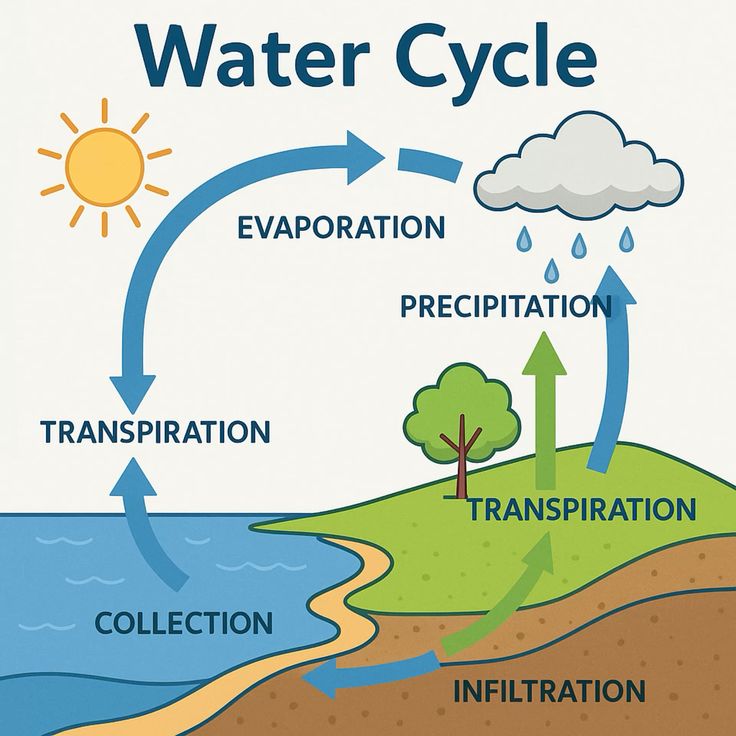
The Hydrological Cycle: A Continuous Journey of Water
The water cycle, also known as the hydrological cycle, describes the unending movement of water on, above, and below the surface of the Earth. It is a complex system that involves the continuous transformation of water between its three states—liquid, vapor, and solid—and its transport across the globe. This process is fundamental to all life, driving weather patterns, supporting ecosystems, and replenishing freshwater resources essential for human civilization and the natural world.
Core Stages of the Water Cycle:
-
Evaporation & Transpiration: Driven by solar energy, liquid water from oceans, lakes, and rivers transforms into water vapor and rises into the atmosphere. Plants also release water vapor through a process called transpiration. Combined, this is often referred to as evapotranspiration.
-
Condensation: As the warm, moist air rises, it cools at higher altitudes. This cooling causes the water vapor to condense into tiny droplets of liquid water or ice crystals, forming clouds.
-
Precipitation: When cloud particles become too heavy to remain suspended, they fall back to Earth. Depending on atmospheric conditions, this occurs as rain, snow, sleet, or hail.
-
Runoff and Infiltration: Upon reaching the surface, precipitation follows two main paths. It either flows over the land as surface runoff, eventually reaching streams, rivers, and oceans, or it infiltrates (seeps into) the soil, recharging groundwater aquifers. This groundwater can later emerge as springs or be taken up by plant roots, re-entering the cycle.
Key Characteristics and Importance:
-
A Closed-Loop System: The cycle is a continuous, closed system with no true starting or ending point. The total amount of water on Earth remains relatively constant, constantly recycled.
-
Solar-Powered: The sun is the primary engine of the cycle, providing the heat energy necessary for evaporation.
-
Crucial for Life: It is the planet's natural water purification and distribution system. It delivers freshwater to terrestrial environments, shapes landscapes through erosion and deposition, regulates climate, and supports all biological processes.
-
Multiple States: Throughout the cycle, water exists in all its physical states—as liquid in oceans and rivers, as solid ice in glaciers and snowpacks, and as an invisible gas (vapor) in the atmosphere.
In essence, the water cycle is the vital circulatory system of our planet, connecting all living things and environments in a dynamic, life-sustaining loop.